
Australian Country - Dec/Jan 2025
A dance through history

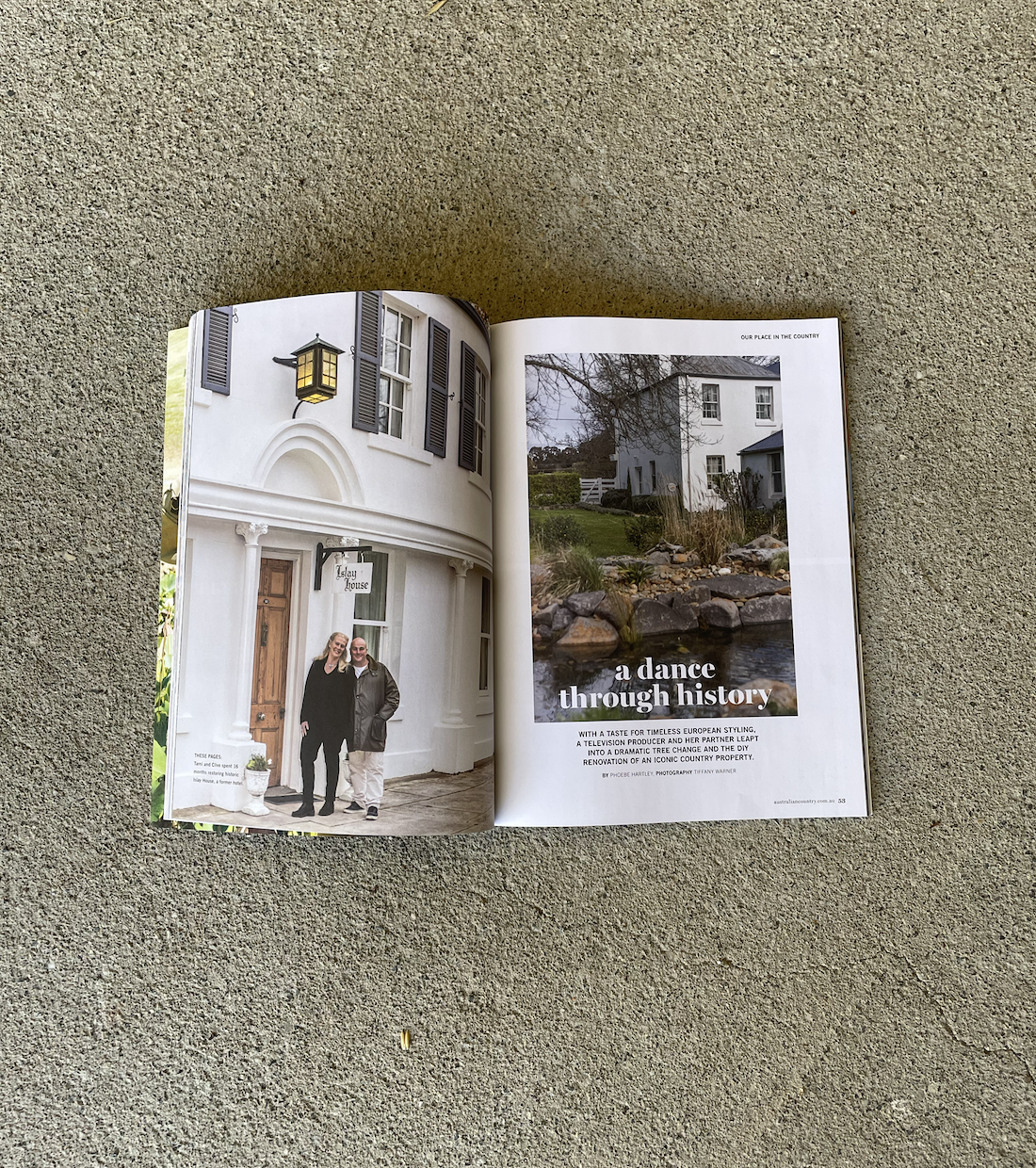
A dance through history
With a taste for timeless European styling, a television producer and her partner leapt into a dramatic tree-change and the DIY renovation of an iconic country property.
When the historic Islay House popped up for sale on Tarni James’ computer screen, she says the two storey colonial Georgian-style building leapt out at her. “I went, ‘There it is, that’s it, that’s the one!’” she says with a laugh. “And so we jumped on it like a seagull on a hot chip.”
The former ABC executive producer of programs including Shaun Micallef’s Mad as Hell and Hard Quiz knew the solid brick and weatherboard house needed a bit of love, and she and her partner Clive Warner — a trained boat builder and furniture maker — were up to the task. “We love renovating old properties,” Tarni says.
The heritage-listed building sits on the main street of Woodend, 70 kilometres northwest of Melbourne, on Dja Dja Wurrung country in Victoria’s picturesque Macedon Ranges. Established in 1860 as the British American Hotel, it was a welcoming rest-stop for prospectors walking from Melbourne to Bendigo during the gold rush. Touted as the town’s most recognised landmark, it had already been updated as a family home when Tarni and Clive took possession.
With a modest budget, the couple spent 16 months lovingly restoring the converted coaching inn, undertaking most of the renovation themselves. They created a home for two in the back section of the property, in what used to serve as the original cookhouse and a bakery, and was separate from the main hotel. Now a private central kitchen joins the whole lot together, while the entire front has been converted into five high-end bed-and-breakfast guest rooms. “We designed to our taste, with influences from France, Greece, England, Scotland and Italy all coming together,” Tarni says. “The key thing was to make every room fit our vision,” Clive adds. “And to also be respectful to the history of the building.”
Clive reinstalled original elements to the facade of the house, stripping back the front door and recreating colonial wooden shutters for the windows. Townspeople regularly offer approval as they pass by. “There’s a sense of ownership from the local community,” Tarni says.
Inside they removed interior walls, blocked up doorways, installed antique light fittings, and ripped out modern cupboards and bookshelves. The reveal of a concealed fireplace was a nice surprise. “These gorgeous handmade bricks appeared behind the plasterboard like a hidden treasure,” Tarni says. “Filthy work to remove it, but so rewarding,” Clive adds. Floor tiles in the bathrooms were replaced with old baltic pine, sourced secondhand. “We wanted the flow from the bedrooms to the bathrooms to be seamless, without a clash between modern elements and beautiful old material,” Clive says.
The guest rooms are furnished with antiques, original art, and secondhand pieces inherited from Tarni’s mother and another close family friend. “When I sit at the piano I remember doing piano practice in her house, so there are lovely memories in a lot of the pieces,” Tarni reminisces. Quirky touches complement the traditional styling. “We fashioned a writing nook out of an old kitchen dresser, and repurposed a butter churn as a bedside table,” Tarni says, adding: “I hate waste, so finding and using existing elements was important — I tried to save every bolt!”
Outside, the magnificent 1400-square-metre grounds feature masses of lavender and English oak trees around lush lawns, which give the formal garden a regal feeling. Tarni and Clive added two large native garden beds, featuring local indigenous plants, “because I want to encourage native birds,” Tarni explains. And a prolific vegetable garden feeds them. “Last summer we didn’t buy any vegetables,” Tarni says. “But we got mighty sick of zucchinis.”
With their previously busy inner-city life, Tarni and Clive originally had no plans to move to the country. But when Tarni’s mother passed away in 2019, the family’s Canterbury house was sold and Tarni was devastated to discover the backyard dance studio her mother had purpose-built was slated for demolition. Tarni’s mother — a well-known local ballroom dancer who went by her stage name Merle Dalmaine — had taught classes in her studio until she was 96.
So a plan was hatched to rescue the dance studio. But could it really be done? “It was a crazy idea, to take down the studio and move it, brick by brick,” Tarni says. “I was struggling to decide, so I thought I’ll write down the pros and cons.” Pulling a notebook at random from a stack on her desk, the answer came to her from beyond the grave. “I opened the book and on the page, in my mother’s handwriting, was a list of the materials she’d bought to build her dance studio, and what it cost.” With that, Tarni made the decision. “It was like staring into Mum’s mind, it was fantastic.”
The need for a country block on which to move the dance studio was the path that led Tarni and Clive to Islay House. And the rest is history — restored, and reinvented. “We are now part of the history of this place,” Clive says. “And we’re bringing another layer to it.” Thrilled with what they’ve achieved, Tarni senses her mother watching over them. “Every night I go outside and look at the stars, it’s glorious,” she says. “I feel like all this is honouring her.”