
Australian Women’s Weekly - Mar 2026
Kindness takes flight
Kindness takes flight
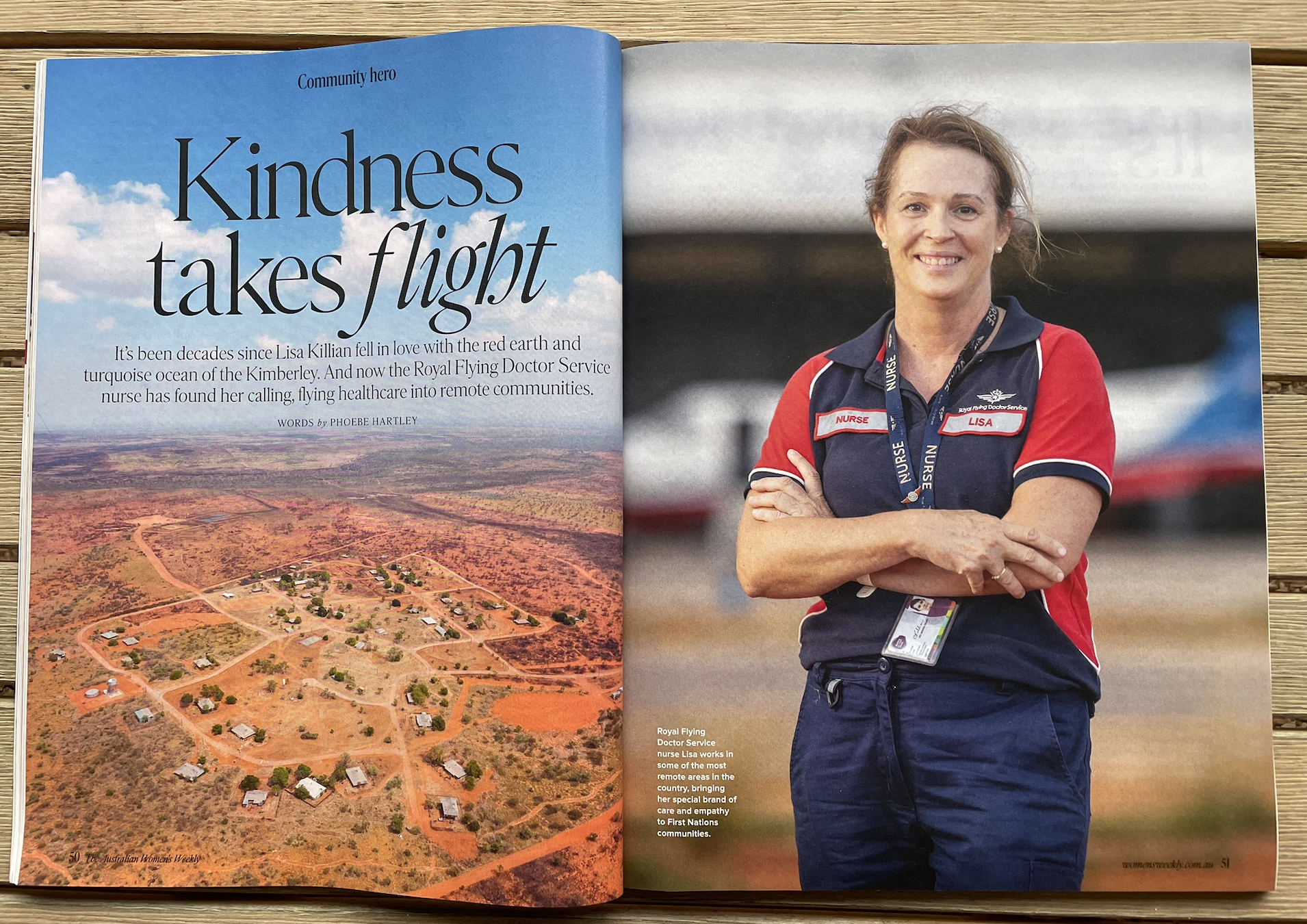
It’s been decades since Lisa Killian fell in love with the red earth and turquoise ocean of the Kimberley. And now the Royal Flying Doctor Service nurse has found her calling, flying healthcare into remote communities.
It’s 7am in Western Australia and Lisa Killian is on her way to work — 8,000 feet in the air. Golden sunlight illuminates the Cessna Caravan aircraft she’s seated in, while red dirt hangs below, edged by swirls of turquoise sea. “It’s absolutely stunning,” Lisa says of the aerial view of the Kimberley region, “but we take this for granted, really.”
The 56-year-old multi-qualified registered nurse — she’s also a midwife, child health nurse and lactation consultant — has been living and working here for 16 years, four of those in primary healthcare for the Royal Flying Doctor Service Western Operations (RFDS WO). Twice a week she flies to remote outposts across the north of the state, to care for the residents of a handful of Aboriginal communities and cattle stations.
Lisa’s the only consistent carer these patients see, with a rotating roster of doctors, specialists and medical students as her co-passengers in the chartered plane. “The relationships I form with my patients is what I love most about the job,” Lisa tells The Weekly back in her office on Yawuru Country in Broome. She says this is particularly important for the remote Aboriginal communities. “Patients get to stay home on Country and speak with a familiar face, rather than having to travel and speak with a stranger to get medical attention,” she says.
With tasks ranging from treating infections and injuries, to administering vaccines and monitoring chronic illnesses, it’s a challenging role, and one Lisa decided she wanted a decade ago. “I heard about… this lady that was flying around doing child health, doing everything,” Lisa explains. “I thought, ‘That’s my dream job’.”
She landed it in 2021 — a huge accomplishment for a woman who left school and her childhood home at 15, and later raised children on her own while studying full-time and working three part-time jobs. “If I embark on something, there’s no failing,” she says. “I see everything to the end.”
Lisa’s early childhood memories are of Port Hedland, where she lived with her English immigrant parents. They divorced when Lisa was very young, and from there she says her upbringing became “complicated”. She ended up in Perth with extended family, feeling displaced and lonely, “because I never belonged”.
But this drove her to forge her own path. “I’m totally independent and really headstrong, and I wanted a good future for myself,” she says. Before her eighteenth birthday she already had years of work experience as a dental hygienist, and then driving forklifts and trucks in the Great Sandy Desert for a uranium exploration company.
As an adult after her own marriage ended, Lisa strived to build a good life for her two kids. “I bought a home at 23 as a young single mum, because I wanted my own home that no one could take from me,” she says proudly.
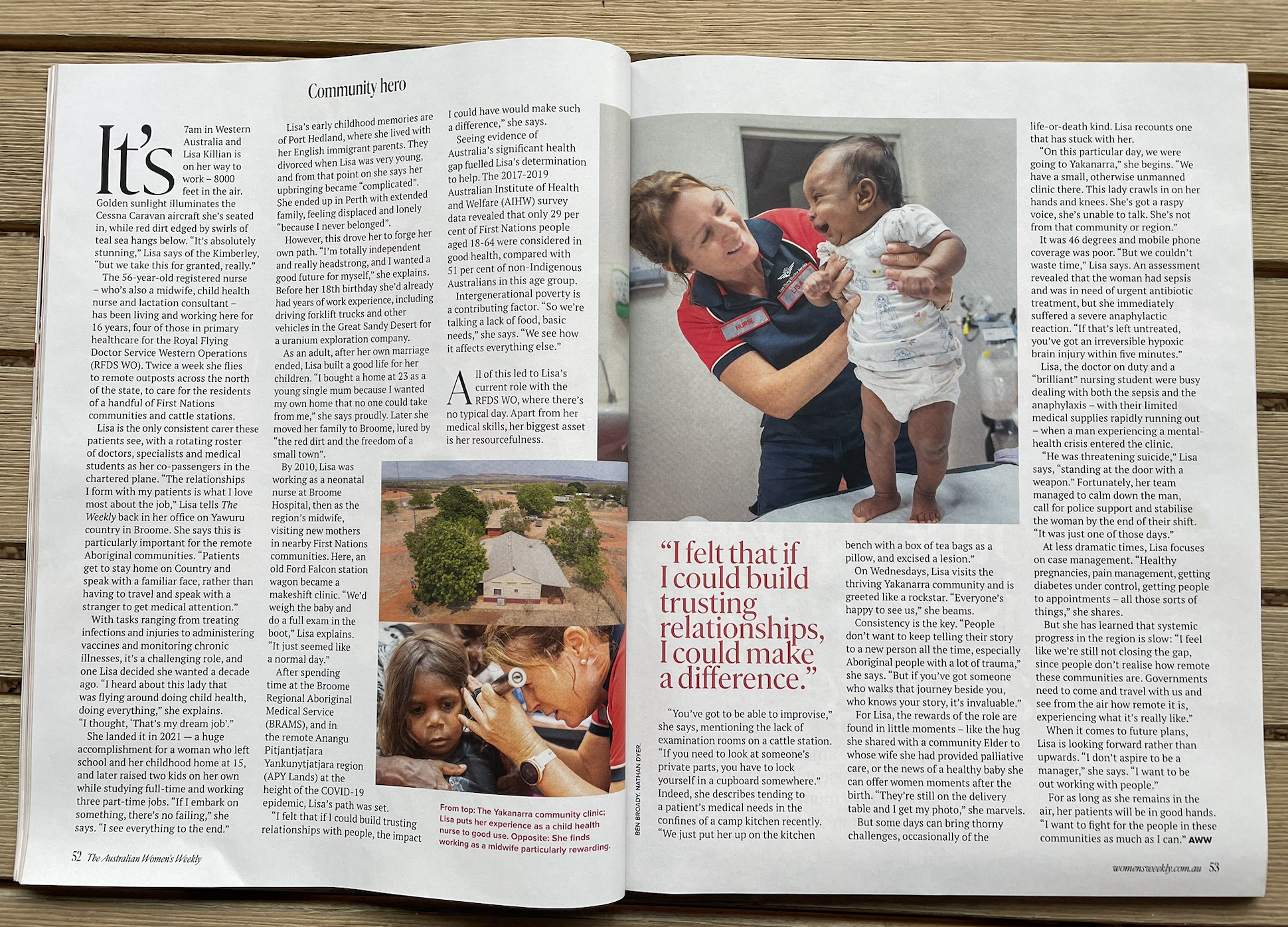
Later she moved her family to Broome, lured by “the red dirt, and the freedom of a small town”. By 2010 she was working as a neonatal nurse at Broome Hospital, and then as the region’s community midwife, visiting new mothers in nearby Aboriginal communities. Here, an old Ford Falcon station wagon became a makeshift clinic. “We’d weigh the baby and do a full exam in the boot,” Lisa explains. “It just seemed like a normal day.”
After spending time at the Broome Regional Aboriginal Medical Service (BRAMS), and in the remote Anangu Pitjantjatjara Yankunytjatjara (APY Lands) during the height of COVID-19, Lisa’s path was set. “I felt that if I could build trusting relationships with people, the impact that I could make, could make such a difference,” she says. Seeing evidence of Australia’s significant ‘health gap’ fuelled Lisa’s determination to help. With the 2017-2019 Australian Institute of Health and Welfare survey data revealing only 29 per cent of First Nations people aged 18-64 are considered to be in good health compared with 51% of non-Indigenous Australians in this age group, Lisa witnessed intergenerational poverty as a contributing factor: “So we’re talking a lack of food, basic needs,” she says. “We see how it affects everything else.”
All of this led to her current role with the RFDS WO, where there’s no typical day. Apart from her medical skills, Lisa’s biggest asset is her resourcefulness. “You’ve got to improvise,” she says, pointing out the lack of private examination rooms on a cattle station. “If you want to look at someone’s personal areas, you’ve got to try and lock yourself in a cupboard somewhere.” She describes tending to a woman’s wound in a camp kitchen recently: “We just put her up on the kitchen bench with a box of tea bags as a pillow, and excised a lesion.”
On Wednesdays she visits the thriving Yakanarra community and is greeted like a rockstar. “Everyone’s happy to see us,” she beams. It’s here that consistency is key. “People don’t want to keep telling their story to a new person all the time… especially a lot of Aboriginal people with a lot of trauma,” she says. “But if you’ve got someone who walks that journey beside you, who knows your story, it’s invaluable.”
For Lisa, the rewards of the role are found in little moments. Like the hug she shared with a community Elder whose wife Lisa had provided palliative care for; and the news of healthy newborns she receives from women, moments after they’ve given birth: “They’re still on the delivery table and I get my photo,” she marvels.
But some days bring difficult challenges, occasionally of the life-or-death kind. Lisa recounts one that has stuck with her: “On this particular day, we’re going to Yakanarra… we have a small unmanned clinic there,” she says. “This lady crawls in on her hands and knees. She’s got a raspy voice, she’s unable to talk. She’s not from that community or even that region.” It was 46 degrees and mobile phone coverage was poor. “But we couldn’t waste time,” Lisa says. An assessment revealed the woman was septic, and needed urgent antibiotic treatment. But she immediately had a severe anaphylactic reaction. “If left untreated, it’s five minutes before you’ve got an irreversible hypoxic brain injury,” Lisa explains.
Lisa, the doctor on duty, and a “brilliant” nursing student were busy dealing with both the sepsis and the anaphylaxis — with their limited supplies rapidly running out — when at the same time a man experiencing a mental health crisis entered the clinic. “He was threatening suicide,” Lisa says, “standing at the door with a weapon.” Fortunately her team managed to calm the man down, call for police support, and get the woman stable by the end of their shift. “It was just one of those days,” Lisa says.
On less dramatic days, she focuses on the day-to-day things she can do to help individual patients: “To get diabetes under control, healthy pregnancies, to get people to appointments, pain management — all those sorts of things,” she says. But she’s learned that systemic progress in the region is slow. "I feel like we’re still not closing the gap because people don’t realise how remote these communities are,” she says. “Governments need to come and… travel with us and see from the air how remote it is, and see what it’s really like.”
When it comes to future plans, Lisa’s looking forward, not up: “I don’t aspire to be a manager,” she says, “I want to be on the ground, working with people.” And for as long as Lisa’s in the air, her patients will continue to be in good hands. “I want to fight for these people in these communities as much as I can.”